
Localization vs translation: what changes on a product page abroad
Your shop already has a German, Spanish or English version, yet orders from the new market still aren’t coming in. The same happens to a beauty salon, a garage or a car rental company with a translated price list. That is localization vs translation in practice: translating an online shop changes the language but keeps the words, size names and price formats of the market where the text was written.
We show this with our own test of 4,894 phrases that AI prepared for 11 markets. We checked selected examples — mattress sizes and the words for car rental — against sellers’ websites in those markets, and the rules against Google’s documentation. We also show the mistakes, including those of our own tool.
The short answer: language is only one of five things to check
In a foreign market, check a product page in five layers:
- Language. Translation takes care of this.
- Sizes and units: whether your size is standard in that market and what it is called there (centimetres, inches, “double”).
- The words the market uses to search for the same product or service.
- How prices, dates and numbers are written.
- Image fields: filename, alternative text (alt) and description.
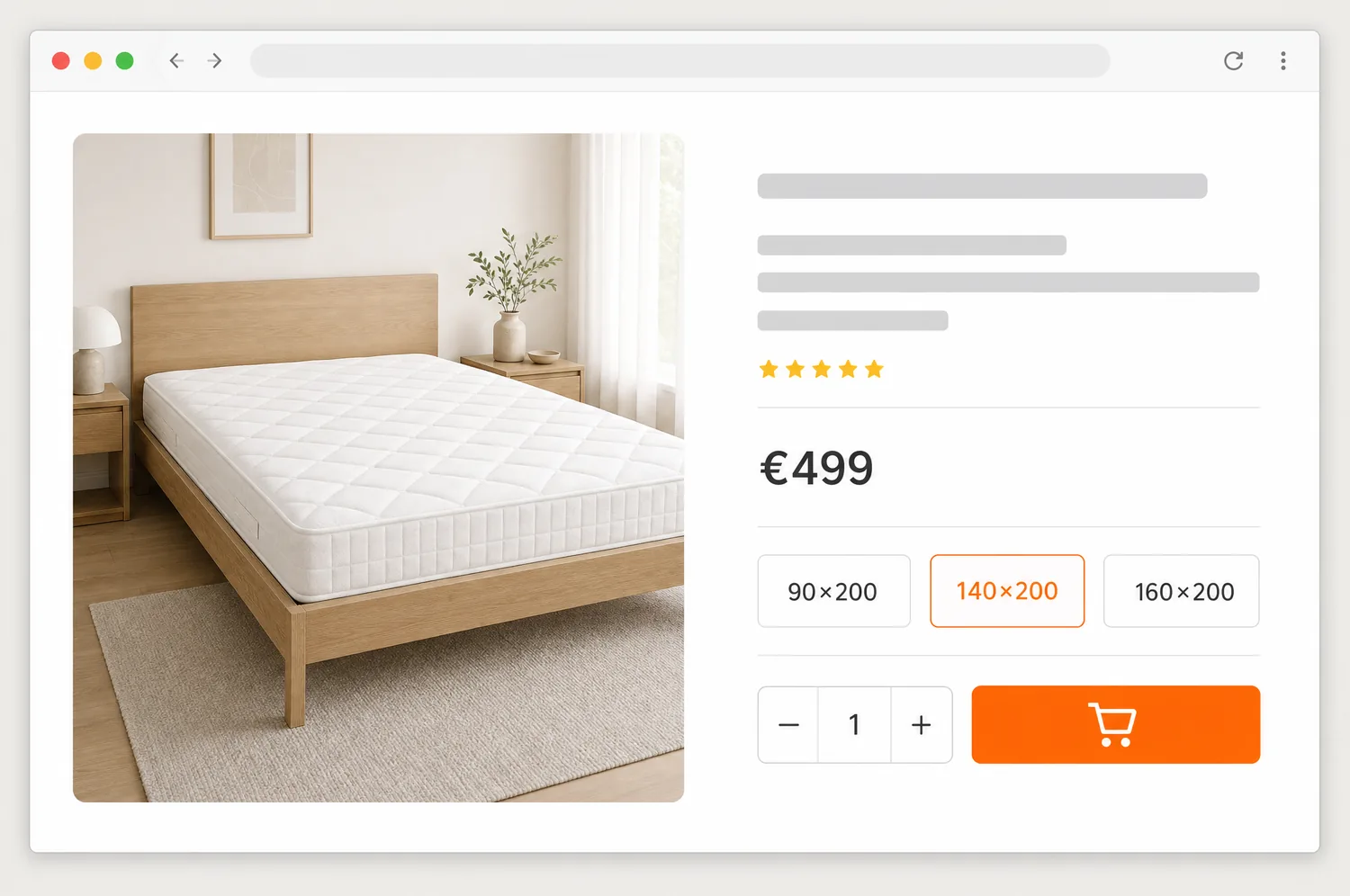
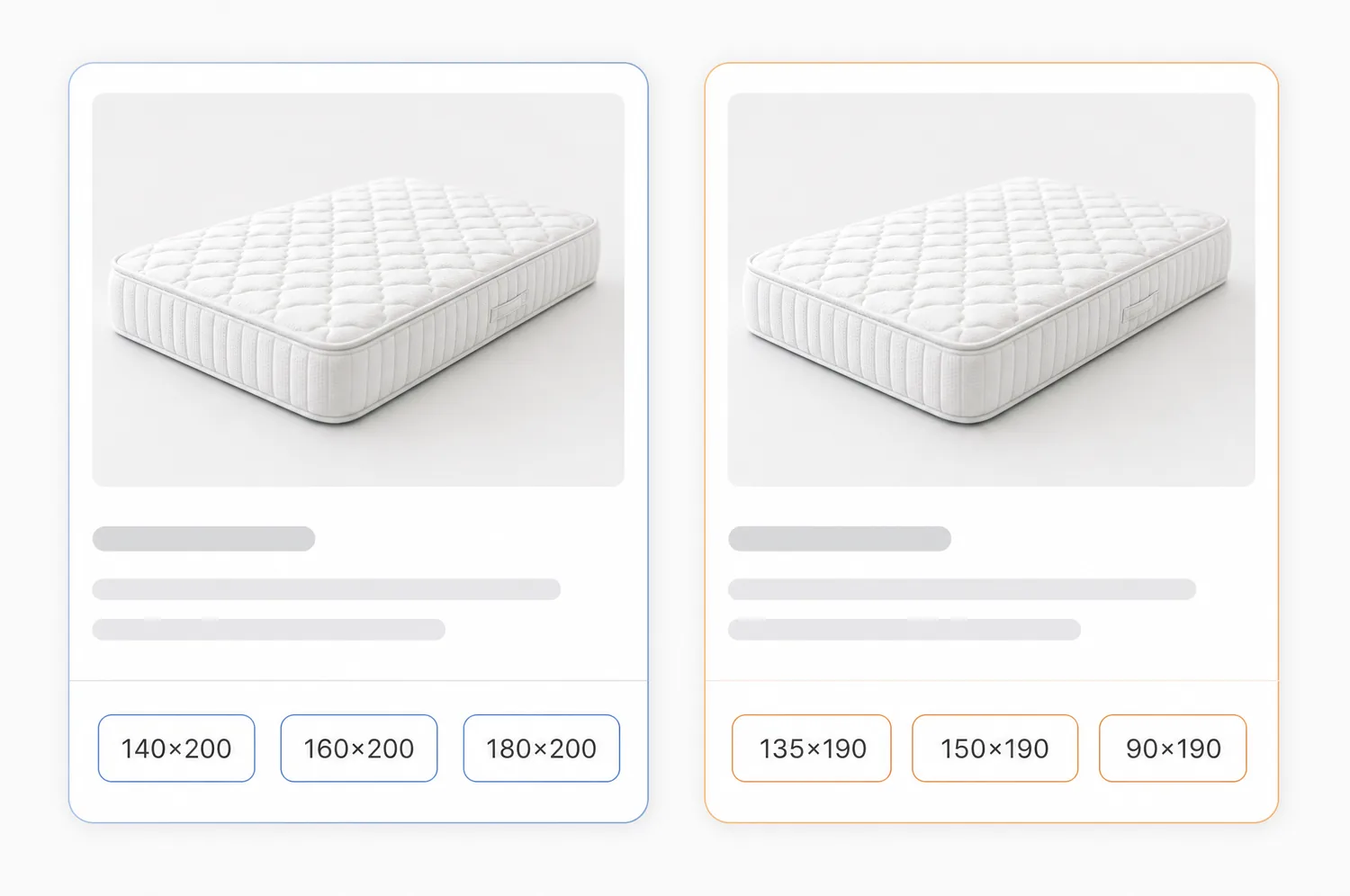
An example: a 140 × 200 cm mattress. In Spain, IKEA and Emma show 135 × 190 and 150 × 190 cm in their mattress categories, so your size is not standard there and the description has to make that clear. In the UK, IKEA and Emma give sizes by name (“Double”, “King”), and Europcar UK has “Car Hire” in its page title, while Avis in the USA has “Car Rentals”.
Sometimes, though, translation alone is enough. At IKEA and Emma in Germany, adult mattresses are at least 200 cm long, so the description of a 140 × 200 cm mattress simply needs translating.
Do shoppers really avoid shops in a foreign language?
In a 2020 CSA Research survey (8,709 consumers in 29 countries), 76% of online shoppers preferred product information in their own language, and 40% said they never buy from websites in other languages. In Germany, 57% of respondents bought only on German-language sites. A caveat: CSA works for the translation industry, and the data is several years old.
Eurostat’s hard data shows that most people shop domestically. In 2023, 83.0% of online shoppers in the EU bought something from a seller in their own country. In Türkiye it was 97.6%, in Luxembourg only 29.7%. Some shoppers also run into a seller that does not ship to them: in 2025, 5.4% of online shoppers in the EU reported the problem “foreign retailer did not sell in my country”, but in Malta it was 35.7%, and in Luxembourg, Ireland and Austria over 25%. Eurostat does not give the reason.
Markets also differ in language skills. In Türkiye, 46.0% of adults know no foreign language, in Spain 43.7% and in Germany 12.3% (Eurostat, 2022, people aged 25–64). The fewer people in a market know foreign languages, the more you gain from a version in that market’s language. That is a good pointer to which version to start with.
Nor is language the biggest obstacle for sellers. In 2025, 20.7% of EU businesses with at least 10 employees sold online, and 43.1% of them sold to other EU countries. The last time Eurostat asked such businesses about difficulties across the whole EU was 2021: delivery and return costs were named by 28.2%, VAT by 16.7%, and lack of knowledge of foreign languages by 10.0%. Translation will not solve the cost of shipping.
Our test: 447 source phrases, 5 industries, 11 languages
The phrases came from the keyword base generator in the ConverterSEO account, in runs on 16 and 29 August 2026. We chose five industries: a beauty salon, a car repair garage, a mattress shop, a lamp shop and a car rental company. The business descriptions gave no city or country.
The source was five lists, one per industry: 447 phrases in 43 categories in total, generated with the same tool in Polish, because that is our team’s language. The generator carried them over to 11 markets: British English, German, Spanish (Spain), Italian, French, Portuguese (Portugal), Czech, Slovak, Lithuanian, Latvian and Estonian. The result was 4,894 target phrases.
- No target phrase is a copy of a source phrase. That only proves that nothing was left untranslated, not that the phrases were written from scratch.
- The lists were adapted item by item. The generator’s prompt requires it: the same categories in the same order and a similar number of phrases. In 41 of the 55 target files, every category has exactly as many phrases as the source.
- How much changes depends on the language. The mattress size changed in 24 of 24 items in English, 22 of 24 in Spanish, 15 of 17 comparable items in Italian (in one category the model added a phrase, so that category cannot be compared), 12 of 24 in French and 11 of 24 in Portuguese. In German, Czech, Slovak and the Baltic languages it did not change at all.
Limits of the method: this is model output, not search volume. On 29 August we checked 150 phrases each from the Polish source and from five target languages in search autocomplete. The share of phrases with a suggestion ranged from 74% for Polish to 16% for Latvian. It roughly tracks the size of the market (the exception is Estonian at 21% against Latvian at 16%), so it mainly tells you how popular a phrase is, not whether it is correct. The queries came from a Polish IP address, so the country setting had almost no effect. We checked the shop websites on 13 September 2026.
Most importantly: this is our own tool, so the errors shown below are its errors.
Same mattress, different dimensions: a size is a fact, not a word
The prompt the generator uses to carry a base over to another market tells it not to translate, but to write what people search for in the target country. It says nothing about sizes, yet in some languages the model changed them. This is how one item from the list looks in each market’s base:
| Market | Phrase in the base | What shops in that market show | Conclusion |
|---|---|---|---|
| Source (Polish list) | materac lateksowy 140×200 (latex mattress 140×200) | – | starting point |
| United Kingdom | latex mattress double | IKEA UK: Standard Double 135 × 190. Emma UK: Double 135 × 190, and 140 × 200 as “EU Double” | the name changes, but “double” is not 140 × 200 |
| Spain | colchón de látex 135×190 | IKEA and Emma: 135 × 190, 150 × 190, 90 × 190 | market size confirmed, but a different product from 140 × 200 |
| France | matelas latex 140×190 | Emma FR: 140 × 190 among the most common. IKEA FR guide: 140 × 190 alongside 140 × 200 | confirmed |
| Portugal | colchão de látex 140×190 | IKEA PT: 140 × 190 | confirmed |
| Italy | materasso in lattice 140×190 | IKEA IT and Emma IT: 160 × 190 and 90 × 190, no 140 × 190 | not confirmed, needs checking |
| Germany | latexmatratze 140×200 | IKEA DE and Emma DE: adult mattresses at least 200 cm long | translation was enough |
| Czechia, Slovakia, Lithuania, Latvia, Estonia | unchanged, e.g. latexová matrace 140×200 | not checked | we don’t know |
| USA (outside our base) | – | IKEA US: Twin, Full, Queen (60 × 80 inches), King | a separate naming system, in inches |
The table gives you the key rule. A 140 × 200 cm mattress does not become a 135 × 190 cm mattress through translation. A size in the keyword base is a hint about what the market may search for, and it has to be checked, as the Italian row shows. On the product page, state the size you actually sell. Adding a local size to your range is a business decision, not a language one.
Check British size names together with the dimensions. Our model usually gave 140 × 200 → double and 160 × 200 → king size, but in the pocket-sprung mattress category it did the opposite. And a double at IKEA UK and Emma UK is 135 × 190 cm.
For clothing and shoes, don’t publish a universal conversion table. Zalando distinguishes five sizing systems (EU, FR, IT, UK, US) and says that brands convert between them differently. Google Merchant Center has a separate attribute for the size system, size_system.
“Hire” or “rental”: the same idea, a different word in each market
The British file in our base writes British English: “tyres”, “orthopaedic”, “petrol”, with none of the American forms we looked for (tires, labor, gas, apartment), and sometimes spells it out: “cheap foam mattress uk”. For car rental, “hire” appears in 75 phrases and “rental” in 3. We count phrases, not occurrences of the word.
That is not a quirk of the model. Oxford Learner’s Dictionaries marks short-term “hire” as British English only, adds that North American English uses “rent”, and notes that “rent” is now sometimes used in British English too. In Spanish, the word changes even between countries:
| Idea | Market | In our base (number of phrases) | Confirmation outside the model |
|---|---|---|---|
| car rental | United Kingdom | hire 75, rental 3 | Oxford: short-term “hire” is British English only. Page titles: Europcar UK “Car Hire”, Avis US “Car Rentals” |
| car rental | Spain | alquiler 70, coche 70, renta 0, carro 0 | Hertz ES and Europcar ES: “Alquiler de coches” |
| car rental | Mexico; Argentina and Colombia | not in the base | Hertz MX and Avis MX: “Renta de autos”. Hertz AR, Avis AR and Budget CO: “Alquiler de Autos” |
| hybrid manicure (Polish “manicure hybrydowy”) | United Kingdom, Germany, Czechia and 4 others; France, Spain, Italy | the equivalent of “gel” (8–11 phrases); of “semi-permanent” (7–12 phrases) | not confirmed |
| loft-style lamp (Polish “lampa w stylu loft”) | United Kingdom, Germany, Spain, Italy, Portugal, Czechia | “industrial” 4, “loft” 0 | not confirmed |
| asking the price of a repair | United Kingdom | cost 28, price 4 | not confirmed |
So a page written for Spain may use different words from car rental companies in Mexico. Check the changes in the lower part of the table against local competitors before you use them.
A trap for SEO specialists: even the word “localization” does not carry over as a keyword. In search autocomplete, German “Lokalisierung” leads to geography, Spanish “localización” to finding a phone, Ukrainian “локалізація” to public procurement among other things, and the Turkish loanword “lokalizasyon” to medicine. In English, typing “shop localization” brings up “shop location”. That is why each language version of this article gets its own keyword from local autocomplete, not a translation of the one chosen for the Polish original.
Prices, dates and numbers: one figure in eight countries
Shoppers read the separator, not just the digits. The same number in a price, written according to Unicode CLDR 48.2.0 data:
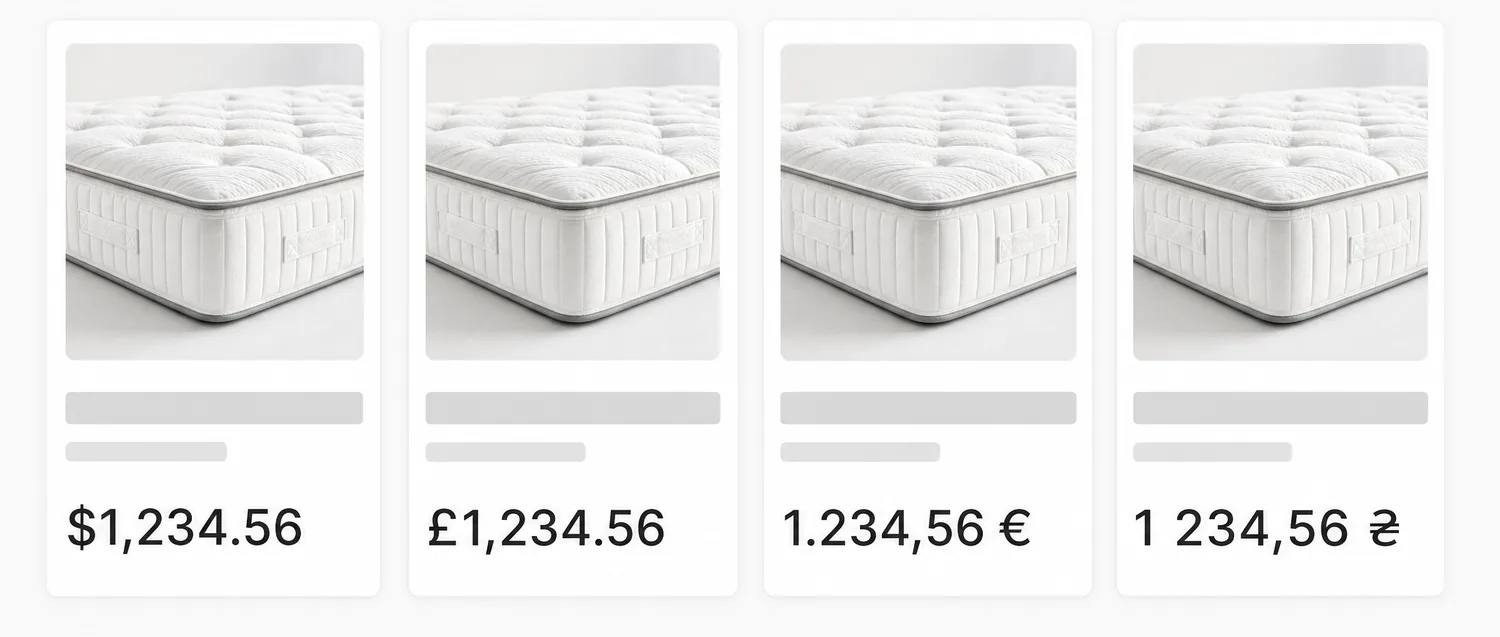
- USA: $12,345.67
- United Kingdom: £12,345.67
- Germany: 12.345,67 €
- France: 12 345,67 € (with a narrow no-break space)
- Spain: 12.345,67 €, but 1234,50 €
- Türkiye: ₺12.345,67
- Ukraine: 12 345,67 ₴
- Poland: 12 345,67 zł
Dates are riskier. In short form, 4 March 2026 is 3/4/26 in the USA and 04/03/2026 in the UK, so a British reader will take the American date for 3 April. In Germany it is 04.03.26, and in Türkiye 4.03.2026. With a delivery date or the end of a sale, a mix-up like that can end in a complaint.
A nuance for specialists: Spanish, Italian and Polish do not put a thousands separator in four-digit numbers. So don’t format prices by hand; use formatting functions for the language and region.
Currency matters to Google too. Its documentation lists local language and currency among the signals of who a page is meant for. It describes a British version with prices in pounds and an American one with prices in dollars as substantially the same content with regional variations. Merchant Center requires the landing page and checkout to be in the language of the product data, and suggests considering full localization of language, price and currency.
Our phrases contain no amounts and no currency symbols at all. Phrases carry intent (“price”, “cost”); how the amount is written belongs on the product page.
Images in a foreign market: filename, alt text and description from local phrases
Guides to ecommerce localization barely mention images. In the ones we reviewed in Brave Search results (13 September 2026), images usually get one sentence about alt text at most, as in Shopify’s guide. The filename and the image description are mostly left out. We covered the basics in our article on how to prepare images for SEO. Here we only cover what changes between markets.
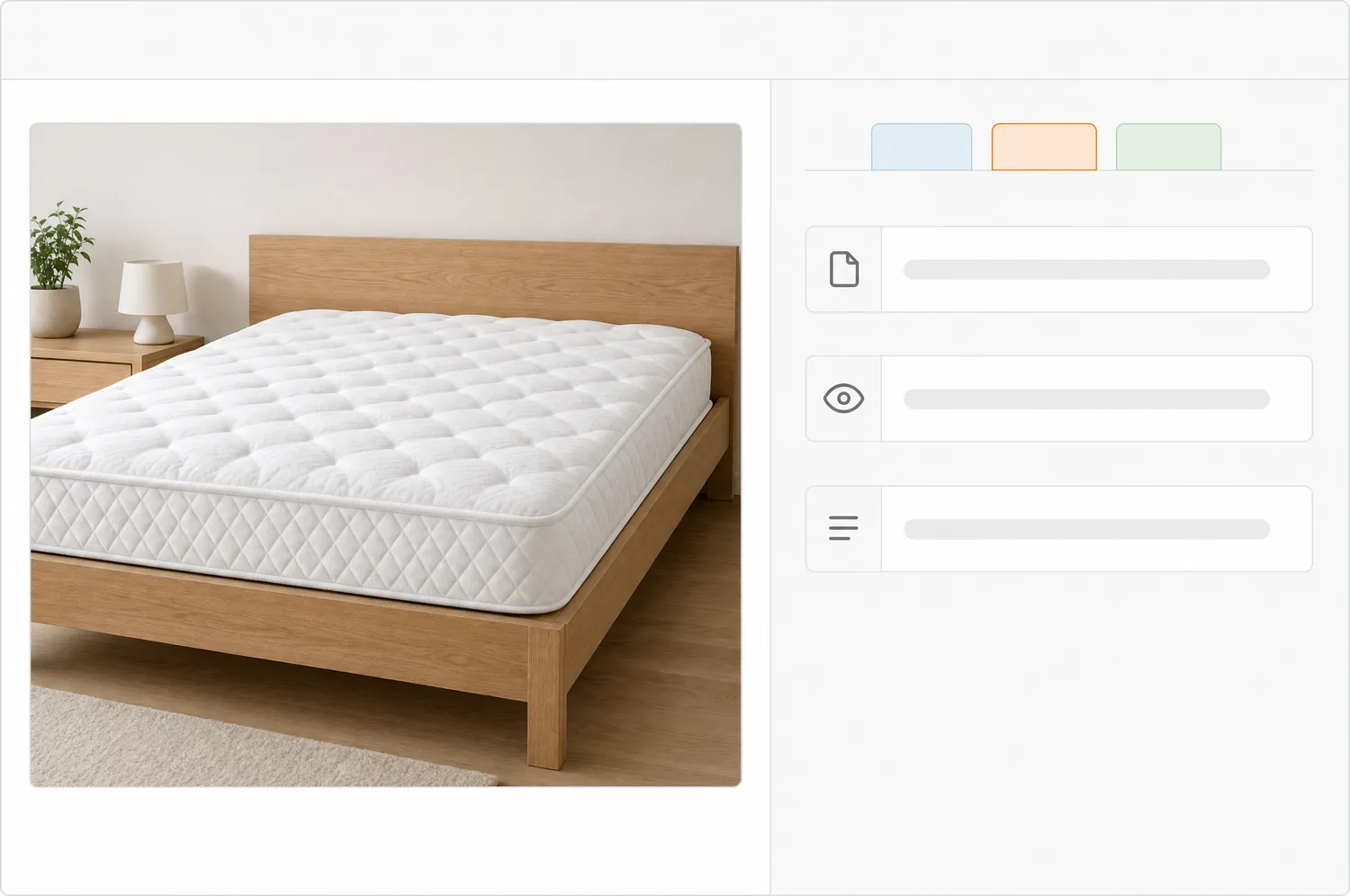
Google’s guidance on images (updated 2 March 2026) says alt text is the most important attribute for describing an image, while the filename gives only “very light clues”. With thousands of images, Google suggests you consider automating the naming; if you localize your images, it says to translate the filenames too. It warns that stuffing keywords into alt text may get a site seen as spam.
Google’s John Mueller, on the other hand, advised in 2020 (as reported by Search Engine Roundtable) keeping a single file when the same image appears in several language versions. The two pieces of advice can be reconciled:
- Alt text and description always separate for each market, written from that market’s phrases, not translated from the source alt text. We explain why in the section Foreign markets: the description is written afresh, not translated.
- A filename in the market’s language when the file is separate anyway: the image is localized, or the platform keeps a copy for each language.
- No copies of an identical image made only to change the filename.
In WordPress, this depends on the language plugin. When Polylang translates media, it does not copy the file; it translates the title, alt text, caption and description, so the Spanish alt text sits on a file named in the source language. On this blog we have that feature switched off, so each language gets its own copy of the image. Without a copy, one file would have one alt text for all languages. A copy gives a separate alt text and description, and a filename in the version’s language comes as a bonus. Mueller added, however, that Google treats identical images under different names as duplicates and merges them into one URL, so the translated name of such a copy may achieve nothing by itself.
| Market | Filename | Alt text | What to watch for |
|---|---|---|---|
| Spain | colchon-de-latex-140×200.webp | Colchón de látex de 140 x 200 cm sobre un somier de láminas | The base suggests 135×190, but the product is 140 × 200 cm, so the real size stays. The “ó” becomes “o” in the filename. |
| United Kingdom | latex-mattress-eu-double-140×200.webp | Latex mattress in EU double size, 140 x 200 cm, on a slatted bed base | A British double is 135 × 190 cm. Emma UK calls 140 × 200 cm “EU Double”. |
| Germany | latexmatratze-140×200.webp | Latexmatratze 140 x 200 cm auf einem Lattenrost | The size is unchanged. You still take the words (“Latexmatratze”, “Lattenrost”) from the market’s base, not from a translation of the alt text. |
| Czechia | latexova-matrace-140×200.webp | Latexová matrace 140 x 200 cm na roštu | Czech phrases almost always have diacritics. Google allows them in URLs once percent-encoded, but we write the filename without them so that the URL stays readable. |
| Ukraine | lateksnyi-matrats-140×200.webp | Латексний матрац 140 x 200 см на ламельній основі | The filename is transliterated from Cyrillic. Check that the “x” in the dimensions is the Latin letter, not the Cyrillic “х”, because in a URL it will turn into a percent code. We did not check sizes in this market. |
In every row, the alt text says the same thing: a 140 × 200 cm latex mattress on a slatted bed base. The image description can be longer but still sticks to the facts, for example in Spanish “Colchón de látex de 140 x 200 cm sobre un somier de láminas, en un dormitorio luminoso”, that is, the same mattress in a bright bedroom.
A few things only show up when you work in many languages at once:
- The size in the alt text is the size in the photo. Add the local size name only when it matches.
- Diacritics. In our base, 411 of the 446 Czech phrases contain letters outside the basic Latin alphabet (ASCII). In Turkish, “ı”, “ş” and “ğ” turn into “i”, “s” and “g” in a filename. Google recommends words in the audience’s language in URLs, transliterated where needed, with hyphens instead of underscores. More in the section Filenames have hard rules.
- Length. An Estonian phrase in our base averages 2.74 words, a Spanish one 4.52. One reason: Estonian, like German, writes compounds as one word, while Spanish adds prepositions, as in “colchón de látex”. Don’t impose one alt text word count on every market.
- A foreign alphabet. In the Lithuanian phrase “natūralaus lateksо čiužinys”, the letter “о” is Cyrillic and looks just like the Latin one. It breaks matching, and in the file’s URL it turns into a percent code.
- Images without text. Google Merchant Center does not accept images with promotional elements such as “free shipping” or a price, and Kaufland Global Marketplace forbids text, logos, symbols and flags in images. An image like that needs no separate version for each language, and it meets this point of the rules of both Google Merchant Center and Kaufland Global Marketplace. Check the other requirements, such as background, dimensions and format, separately.
What adaptation won’t fix: errors in the source and new errors from the model
Item-by-item adaptation also carries over the source’s errors, and “localizes” some of them on top.
- An out-of-date year. The Polish phrase “najlepszy materac hybrydowy 2024”, in data from 2026, ended up in all 12 files, for example as “best hybrid mattress 2024”.
- Invented places. The business descriptions gave no city, yet the source list added the capital and its airport. The airport was swapped for a local one in all 11 languages (“car hire Heathrow”), and 4 languages swapped the capital for a local one. A company with no branch at Heathrow should not have a phrase like that.
- False origin. The source phrase “materace producent polski” (mattresses, Polish manufacturer) became local in every language: “british made mattress”, “matratzen made in germany”, “colchones fabricados en España”. For any one shop, at most one of those claims is true.
- An unknown scale. The H3 firmness rating stayed in 8 of 11 languages. We don’t know whether shoppers in Italy, Portugal or the Baltic states use it.
- Typos. The Estonian typo “iluslong” appears in 6 phrases, the correct “ilusalong” in 2. There is also the German “matratratzen”, the Latvian “autoservisss” and 28 duplicates in the target files, although the source had none.
- An ambiguous source. “Przegląd okresowy” (literally “periodic check”) can mean a routine service or the mandatory vehicle inspection. Only 4 of 11 languages got the name of the official inspection: German (“Hauptuntersuchung”), Czech (“STK”), Italian (“revisione”) and Lithuanian (“techninė apžiūra”).
Adaptation can also fix things: in all 11 languages, the model turned the meaningless source phrase “kwadratowy pisk hamulców naprawa” (literally “square brake squeal repair”) into an ordinary query, for example “squeaking brakes fix”.
We slipped up too. The image descriptions the ConverterSEO plugin wrote for our article on image file size and its 20 translations were promotional and in places untrue. They promised compression “without loss of quality”, and on a photo of a mug they inserted phrases about a free WordPress plugin. Every one of them had to be corrected before publication. In its guidance on content created with the help of AI, Google asks for accuracy in automatically generated metadata and names alt text explicitly. Kaufland Global Marketplace does not allow automatically generated translations in product descriptions.
What Google says about translated pages, and what it does not
Duplicates. According to Google’s documentation, language versions of a page are duplicates only if the main content has been left untranslated.
Page language. Google works it out from the visible content, not from the lang attribute or the URL. One page, one language. Translating only the menu and footer can make for a poor user experience when the same content shows up in results many times with navigation in different languages, typically with user-generated content.
URLs and tags. The technical minimum worth passing on to whoever runs your site:
- A separate URL for each language version instead of cookies or browser settings.
- No automatic redirects based on IP address or a guessed language. Googlebot usually crawls from the USA and without an Accept-Language header.
- Hreflang tags must point to each other, otherwise Google ignores them. Only ISO codes work: es-419 is not supported, and “UK” has no effect. For the United Kingdom, the correct region code under ISO 3166-1 is GB.
Machine translation. Google’s current spam policy (updated 28 August 2026) mentions translation only in an example of automatically transforming scraped content that gives users little value. The version from early 2024 still listed text translated by an automated tool without human review. Google removed its advice to block automatically translated pages in robots.txt on 11 June 2025, noting that only the documentation was changing, not how Search works.
The guidelines for search quality raters (September 2025) count the automatic creation of thousands of pages from freely available content, run through translation software without oversight, as showing no effort. That describes a content farm, not a shop translating its own catalogue, and raters’ scores do not directly affect ranking. So there is no basis for saying that Google punishes machine translation. What counts is value and review.
Synonyms. Google’s guide to AI search (July 2026) says AI systems understand synonyms, and that separate content for every variant of a query, created mainly to manipulate rankings, breaks the spam policies. In one market, then, one page written with the word that market uses is enough, not separate pages for “car hire” and “car rental”. You choose the word for the customer who reads the search result and the page, not to help Google understand the query in the first place.
What Google won’t do for you. It can translate the title and snippet of a result in a foreign language, but only into 21 languages, and it does not host translated pages. The list includes English, Turkish, German and Spanish, but not Italian, Polish, Czech or Ukrainian.
When translation alone is enough
The rule in one sentence: translation is enough when the target market uses the same sizes, units, standards and names as the source market. If even one of those differs, it is not enough.
It is enough, for example, for German mattresses 200 cm long. Beware of things that only look universal, though, because even international words change: “diesel” is “diésel” in the Spanish base, and instead of “leasing” the Spanish base says “renting”.
It is not enough with a different sizing system, or with one language spoken in several countries (British and American English, Spain and Mexico). Nor is it enough for claims about origin and place, or for errors in the source.
Take care with payments. Only in three languages did the model replace the literal “na raty” (in instalments) with a local expression, for example “buy mattress on finance” and “matelas paiement en plusieurs fois”. It translated the rest literally. Check with local sellers which expression works in a given market.
What ConverterSEO does for you, and what is still your job
ConverterSEO, which produced the data for this test, handles the image layer, not the whole product page.
- What it does. In your ConverterSEO account you build your business’s keyword base and carry it over to further markets, with the same mechanism that produced the phrases in this test. You can review and correct each market’s base before you use it. From that base, the plugin in WordPress writes an image’s title, alt text, description and filename for one of 29 markets in 24 languages. For each further market it saves the image as a copy of the file, without compressing it again, with its own title, alt text, description and filename. It will not rename a file whose URL is already written into the content of a published page.
- What is free. Compression to WebP and the media library audit, without limits, on every plan. Both run on your own site’s server. You start compression yourself, for one image or for many at once from the audit screen. A file is processed once, never while a customer is visiting. More in our article on image file size for a website.
- How the paid part is counted. One description is one image in one language, so an image in four markets is four descriptions. Building and carrying over the keyword base does not use up your description allowance. The only limit is how many times a day you can do it: 4 on the Free plan and 25 on paid plans. The Free plan gives you a one-off 5 descriptions and one extra language to try. Prices in your currency are on the pricing page.
- What it won’t do. It won’t write your product description or the product page title, choose sizes, format prices or set up hreflang tags.
- What stays with you. Reviewing the keyword base (years, cities, “made in”, scales) and the image descriptions before publishing. The errors shown above were made by our generator, and the descriptions for our own article needed correcting too.
Checklist: your product page before you enter a new market
- Sizes. Compare your dimensions with two large sellers in the target market and decide: a local size in your range, or an honest description of yours.
- Size names. Where the market uses them (Double, King, Queen), give the name together with the dimensions and check that the two match.
- Words. Use the word that market leaders use in their page titles (“hire” or “rental”, “coches” or “autos”), not the one from the dictionary.
- Phrases. For each language version, pick phrases from search autocomplete set to the market’s language instead of translating the source ones. A lack of suggestions in a small market does not mean a phrase is wrong.
- Claims. Remove from the keyword base and the descriptions any year, city, airport, “made in” claim or scale you cannot back up in that market.
- Prices and dates. Local currency, and number and date formats taken from language and region settings, not typed in by hand. Check delivery dates.
- Image alt text and description. Separate for each market, from that market’s phrases, about what the image shows. No keyword stuffing, no personal data from the photo and no promises the product does not keep.
- Filename. In the market’s language when the file is separate: lowercase, transliterated, hyphens. Don’t copy an identical image just for the name.
- Images without text, prices or flags. One image like that needs no separate version for each language. Check background, dimensions and format against the rules of each marketplace.
- Technical setup. A separate URL for each language, hreflang pointing both ways, ISO codes (GB, not UK; no es-419), no redirects based on IP.
- Human review. Read everything written by AI or a machine translator before you publish. Kaufland Global Marketplace explicitly forbids automatic translations in product descriptions.
- Image format. Before you list products on a marketplace in that market, check where you can send WebP, and where you cannot.